i would be wary of studying their high-profile demos like ADAM though they write bespoke just-for-demo systems that never ship plus those projects are kinda a mess to navigate (smells like trade show demo deadline stress)
@FourColumns here’s a simple example… i create a uv vector field, add data for it to the DOPs simulation, advect it through the velocity field, then use that UV field to look up a texture in the material
class GifPlayer(PySide.QtGui.QWidget): def __init__(self, gifFile, parent=None): PySide.QtGui.QWidget.__init__(self, parent) self._gif = gifFile # set up the movie screen on a label self.movie_screen = PySide.QtGui.QLabel() # expand and center the label # self.movie_screen.setSizePolicy(PySide.QtGui.QSizePolicy.Expanding, # PySide.QtGui.QSizePolicy.Expanding) # self.movie_screen.setAlignment(PySide.QtCore.Qt.AlignCenter) main_layout = PySide.QtGui.QVBoxLayout() main_layout.addWidget(self.movie_screen) self.setLayout(main_layout) # use an animated gif file you have in the working folder # or give the full file path self.movie = PySide.QtGui.QMovie(self._gif, PySide.QtCore.QByteArray(), self) self.movie.setCacheMode(PySide.QtGui.QMovie.CacheAll) self.movie.setSpeed(100) self.movie_screen.setMovie(self.movie) self.movie.start()
We used to have a gif fail player show up on export failures 😃
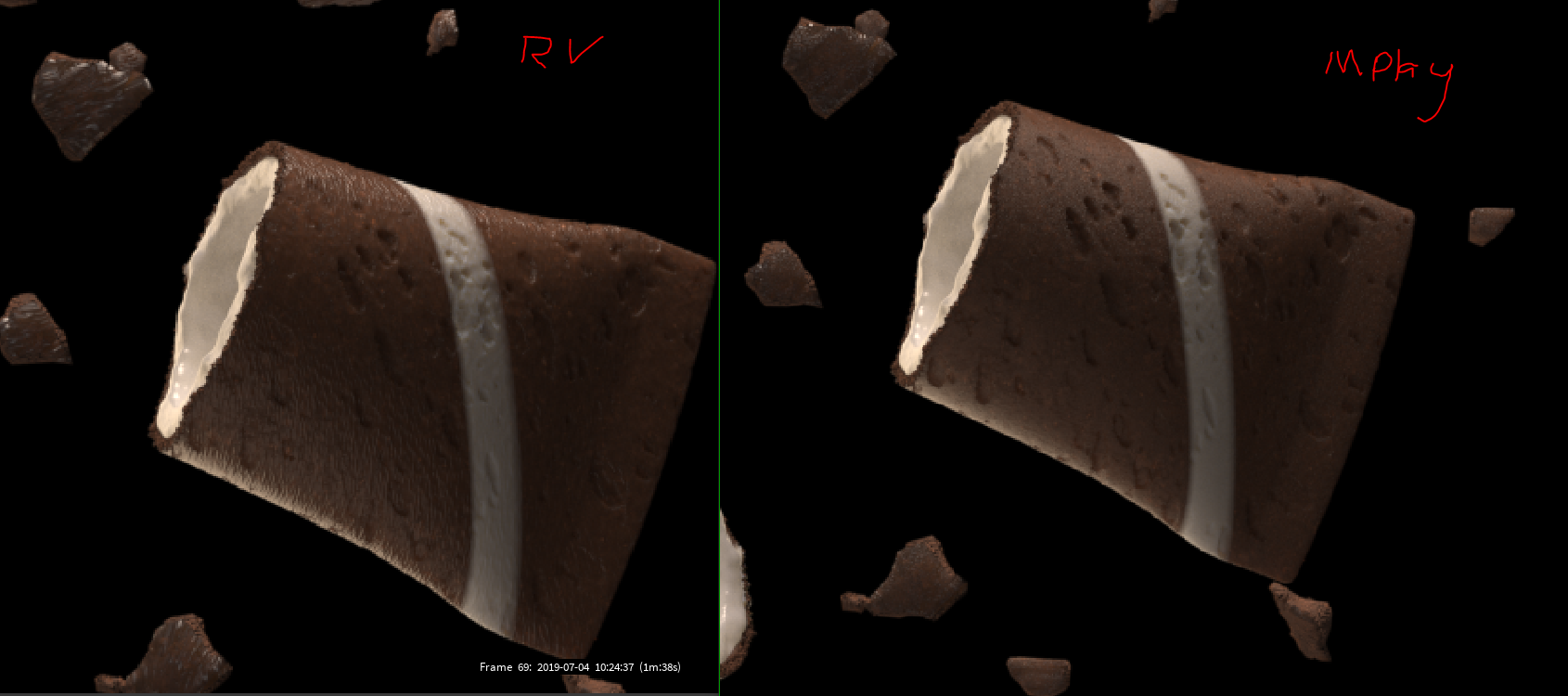
heck, redshift issue. Redshifts RenderView is producing different results to images rendered to disk or mplay.
its like the displacment/bump changes. These area both gamma 2.2
what the heck does this mean `Found conflicting usage types for vertex stream ‘ns’! Original usage is ‘Unspecified’, while another shader is using it as ‘Unspecified’. Please duplicate or use a different vertex stream and assign separately.`
p simple actually This is a volume wrangle. First input is your volume for storing the field, second input is your geometry that has a magnetic value (-1 to 1) point attribute “`c vector mf = 0;
for( int i=0; iv@magfield = mf;“`
trying to convert to openCL but running into dumb problems with how to write to vector volumes
of course, it also doesn’t take into account spatial density of points, so if you double your point count you will get double the magnetic field values
yeah, thanks I’ll check it out. This is literally just my prep so I begin setting up cloth tutorials
at the risk of looking inefficient, but for future posterity when I forget how I did this, here is a bit of code to transition between multiple clips in an agent
fun hot tip, inside your $HFS/ocl/compute folder, the team at sesi has included both a simple sparse matrix vector multiplication function as well as a bunch of opencl vector functions, including parallel reduction for large dot product operations 😮