like so:
Attachments in this post:
http://fx-td.com/houdiniandchill/wp-content/uploads/discord/20252410/22/25/explorer_LzCduZq25w.mp4
like so:
Attachments in this post:
http://fx-td.com/houdiniandchill/wp-content/uploads/discord/20252410/22/25/explorer_LzCduZq25w.mp4
thanks man these are nice. he is using polycut, nice use case for this node
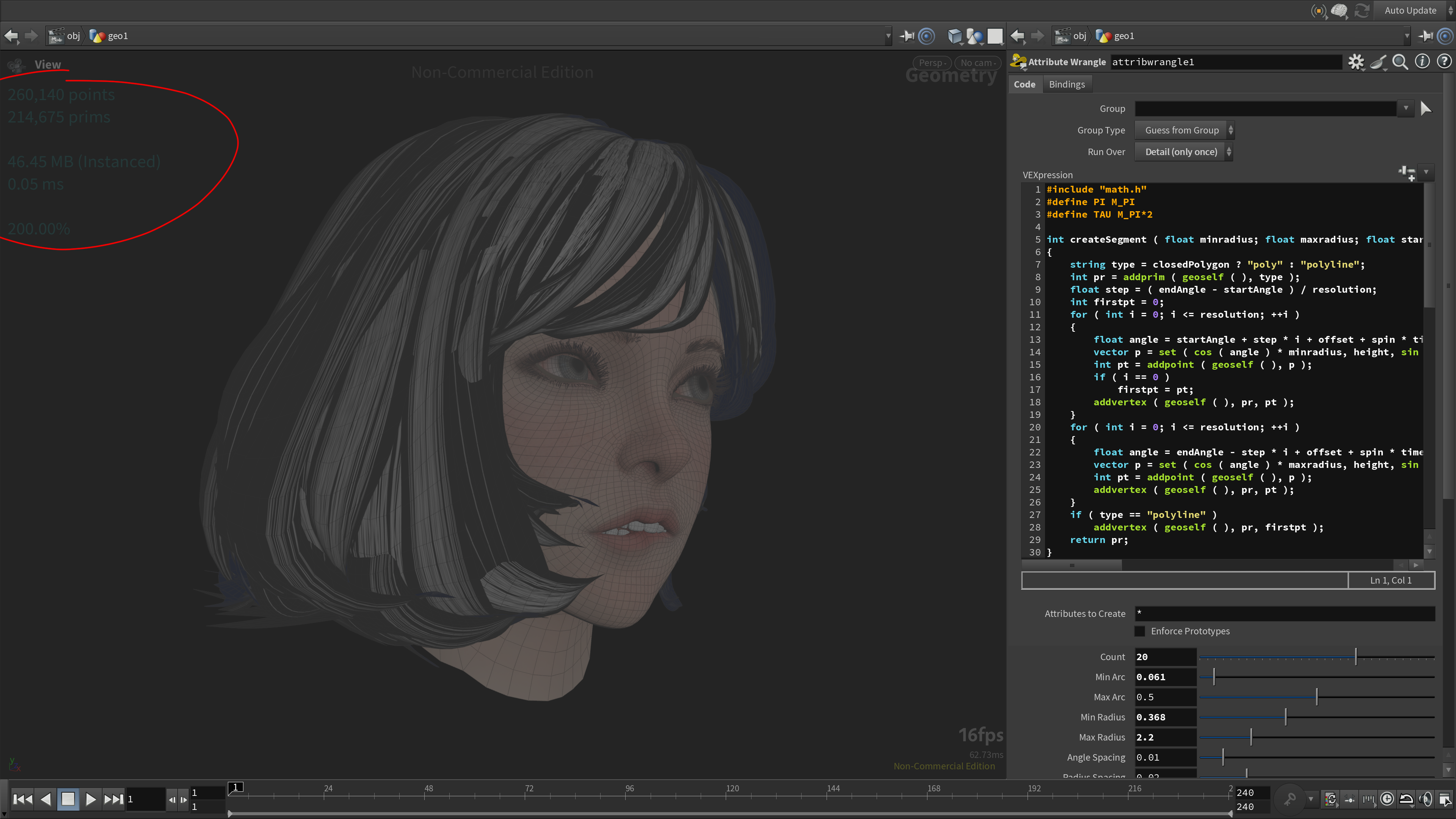
Anyone know the nodegraphtitle.py trick? I searched here but there is no mention of it. If you override this file in your user directory, you can have custom stats on the network editor like this (top left).
I use this code:
“`python from __future__ import print_function import hou import nodegraphprefs as prefs
def networkEditorTitleLeft(editor): try: title = ‘\n’
#title += “Viewport\n\n”
selectedNodes = hou.selectedNodes() if len(selectedNodes) == 1 and hou.ui.updateMode() == hou.updateMode.AutoUpdate: currentNode = selectedNodes[0] nodePath = currentNode.path()
#title += str(len(currentNode.geometry().points())) ptcount = int(hou.hscriptExpression(“npoints(\”” + nodePath + “\”)”)) primcount = int(hou.hscriptExpression(“nprims(\”” + nodePath + “\”)”))
title += str(f'{ptcount:,}’) + ” points\n” title += str(f'{primcount:,}’) + ” prims\n\n”
opinfo = hou.hscript(“opinfo -n ” + nodePath)[0]
if “Memory: ” in opinfo: memory = opinfo.split(“Memory: “)[1].split(“\n”)[0] if ‘;’ in memory: # Split the text at the first ‘;’ occurrence parts = memory.split(‘;’, 1) # Rejoin with the second part encapsulated in parentheses memory = f”{parts[0]} ({parts[1].strip()})” title += memory + “\n”
cooktime = opinfo.split(“Last Cook Time: “)[1].split(“\n”)[0] title += cooktime + “\n\n”
screenbounds = editor.screenBounds() # Figure out how much we need to scale the current bounds to get to # a zoom level of 100 pixels per network editor unit. bounds = editor.visibleBounds() currentzoom = editor.screenBounds().size().x() / bounds.size().x() title += “{:0.2f}%\n”.format(currentzoom)
“`
“`python pwd = editor.pwd() playerparm = pwd.parm(‘isplayer’) if playerparm is not None and playerparm.evalAsInt() != 0: title += ‘Network in Playback Mode\n’ if prefs.showPerfStats(editor): profile = hou.perfMon.activeProfile() if profile is not None: profiletitle = profile.title() if not profiletitle: profiletitle = ‘Profile ‘ + str(profile.id()) title += profiletitle + ‘: ‘ + prefs.perfStatName(editor)
except: title = ”
return title
def networkEditorTitleRight(editor): try: title = ” pwd = editor.pwd() title += pwd.childTypeCategory().label()
except: title = ”
return title “`
Attachments in this post:
http://fx-td.com/houdiniandchill/wp-content/uploads/discord/20251010/18/25/image.png
your primary driver is _what_ scale are you rendering at? everything else is just a scaling factor going from that to the preferred working scale of the solver. Pyro will handle very small values, and very large ones fine, so you don’t tend to mess with the working scale. 1m is 1m for example.
FLIP is notorious for being fiddly as small scale, so anything under 1m in real world size you tend to work in larger scales. Example, simming liquid pouring in to a glass, real size might be 0.1m, but you would generally work at 10x that in FLIP. But on the other end, if the scene is 10m or 100m or 1000m you would leave FLIP at normal scale.
Bullet similar deal. Anything with pieces under 1-2cm can be a pain, so we routinely work 10x in scale. But if your smallest piece is going to be decently sized you might not change working scale at all.
Vellum is roughly based around real-world, so pretty much never change this working scale.
Heightfields, it really just comes down to working in the scale that the solver/defaults are built around.
At the end of it, you’re really only talking about working in the scale best for the solver/technique, and then scaling to render scale for output/lighting.
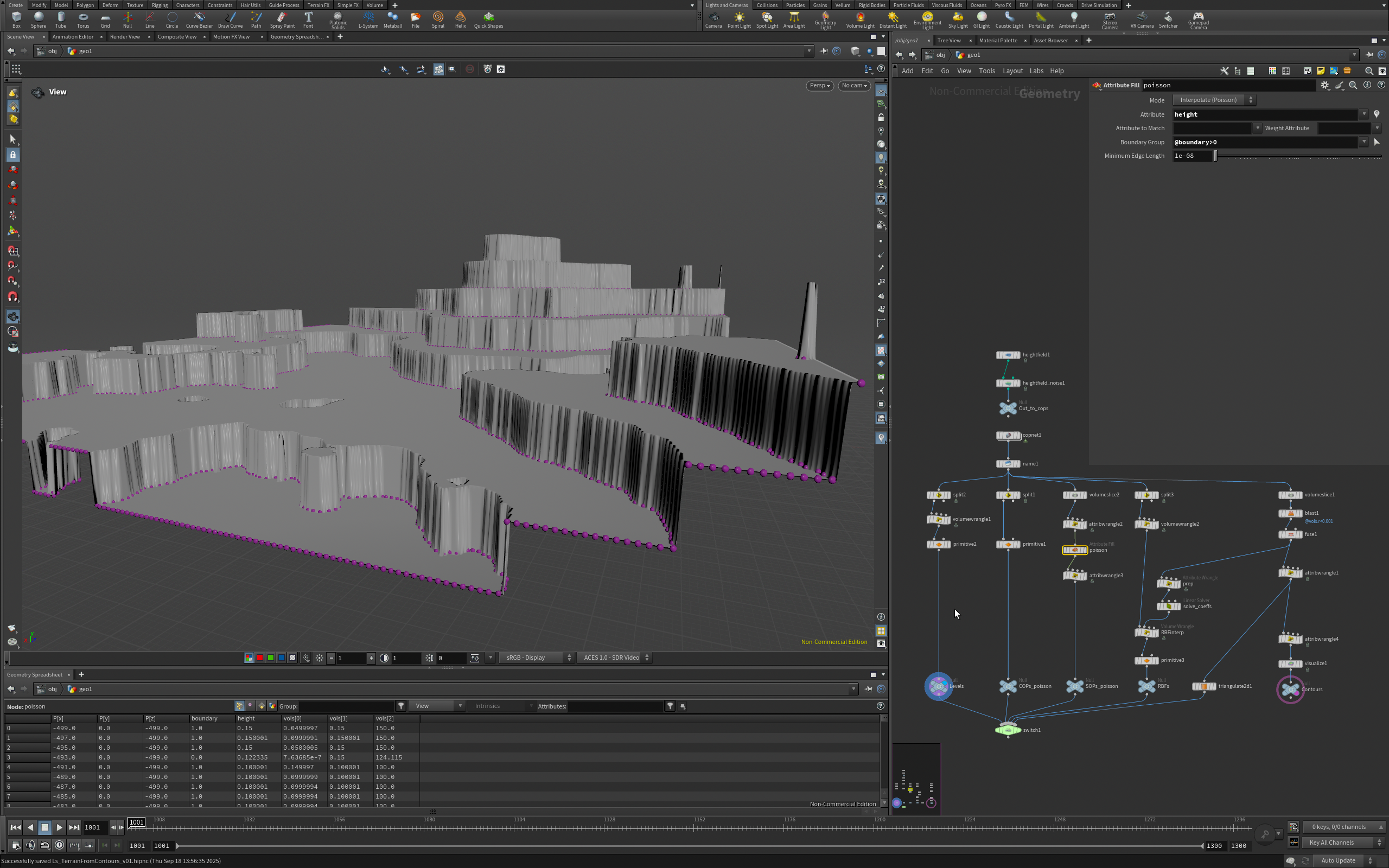
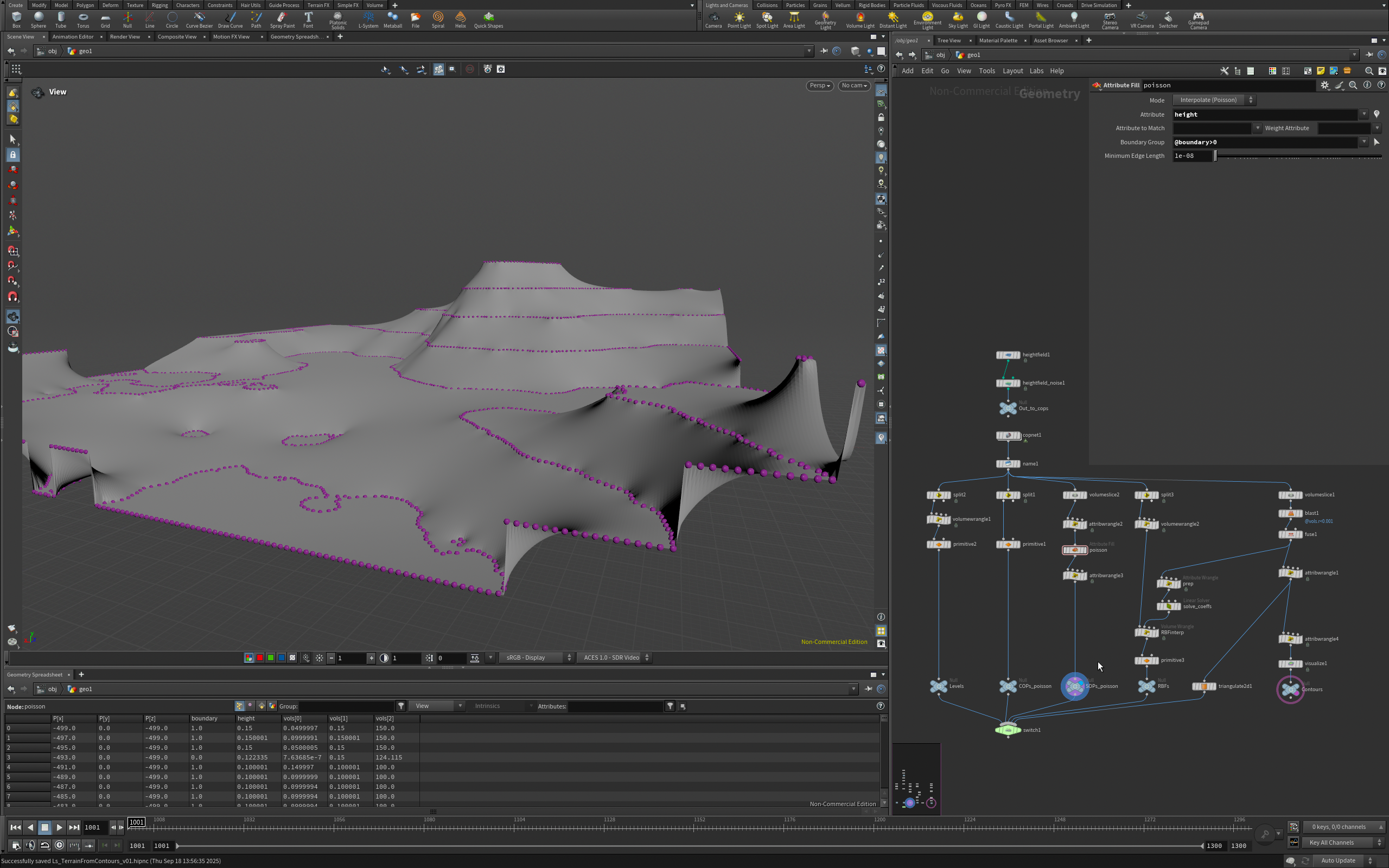
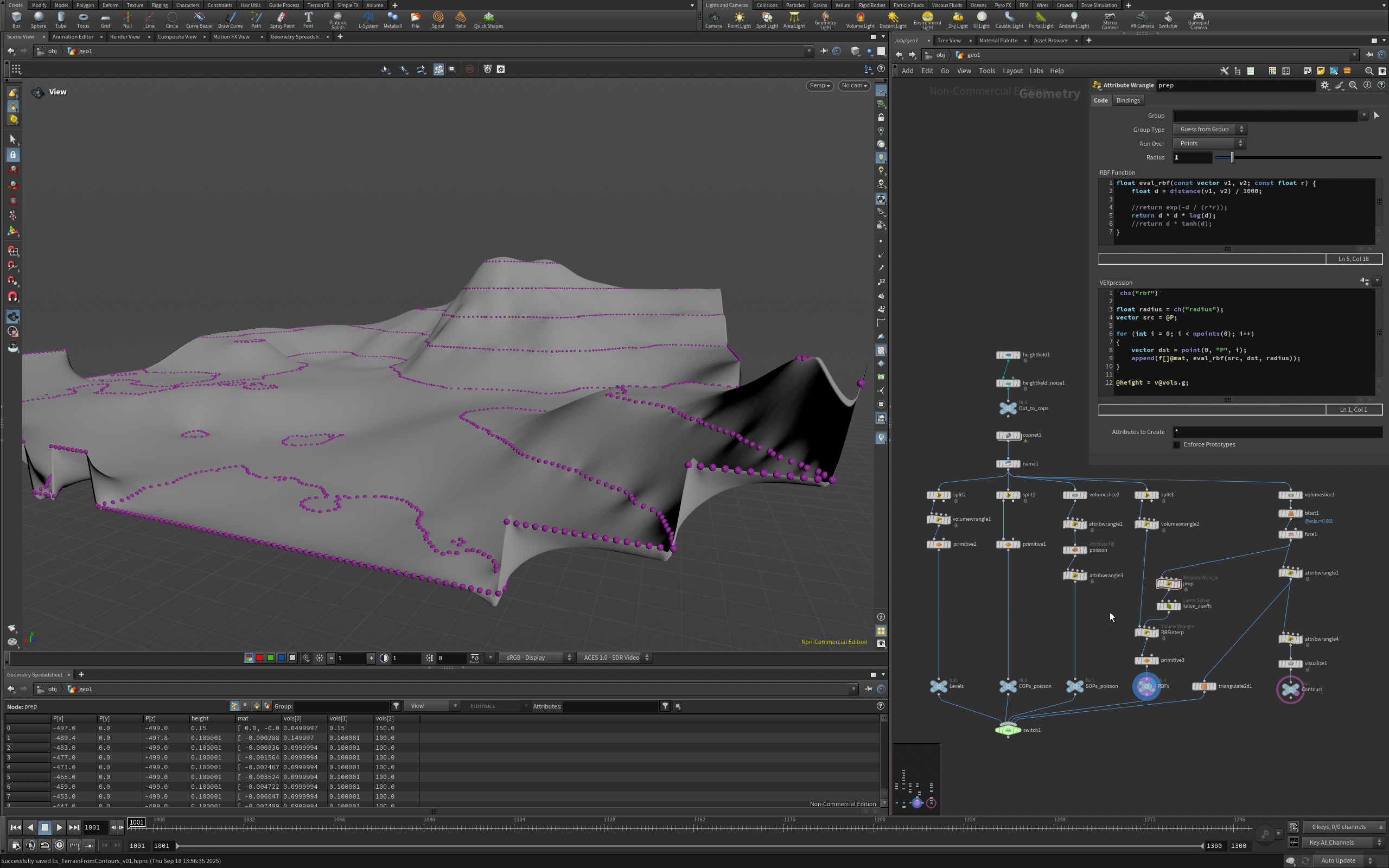
poisson with the smooth fill COP or the attribute fill SOP leave the contour lines pretty visible because they only try to stay C0 smooth… i fear we must reach for everybody’s favourite
the help has an RBF interpolation that i just adapted and keeps things much smoother… good example of how brittle the linear solver can be as well though, changing the RBF function or the numerical range of the inputs can instantly stop it converging or make it output nonsense
Attachments in this post:
http://fx-td.com/houdiniandchill/wp-content/uploads/discord/20253909/18/25/Linear_Solver_SOP.jpeg
http://fx-td.com/houdiniandchill/wp-content/uploads/discord/20253909/18/25/Screenshot_2025-09-18_at_13.57.21.png
http://fx-td.com/houdiniandchill/wp-content/uploads/discord/20253909/18/25/Screenshot_2025-09-18_at_13.57.25.png
http://fx-td.com/houdiniandchill/wp-content/uploads/discord/20253909/18/25/Screenshot_2025-09-18_at_13.57.36.png
http://fx-td.com/houdiniandchill/wp-content/uploads/discord/20253909/18/25/Ls_TerrainFromContours_v01.hipnc
Hi everyone, I created some themes for Houdini. Of course, just ping me or put in an issue if you see anything that’s wonky or could get improved. Cheers 🙂 github.com/beatreichenbach/houdini-themes
docs.google.com/document/d/1HBQ6CwiDX0MbK7-nBrLU8hF8H08uPbewZF1z8ybdRw0/edit?tab=t.0
also unrelated but this file is ridiculously fast
Attachments in this post:
http://fx-td.com/houdiniandchill/wp-content/uploads/discord/20251409/12/25/image.png
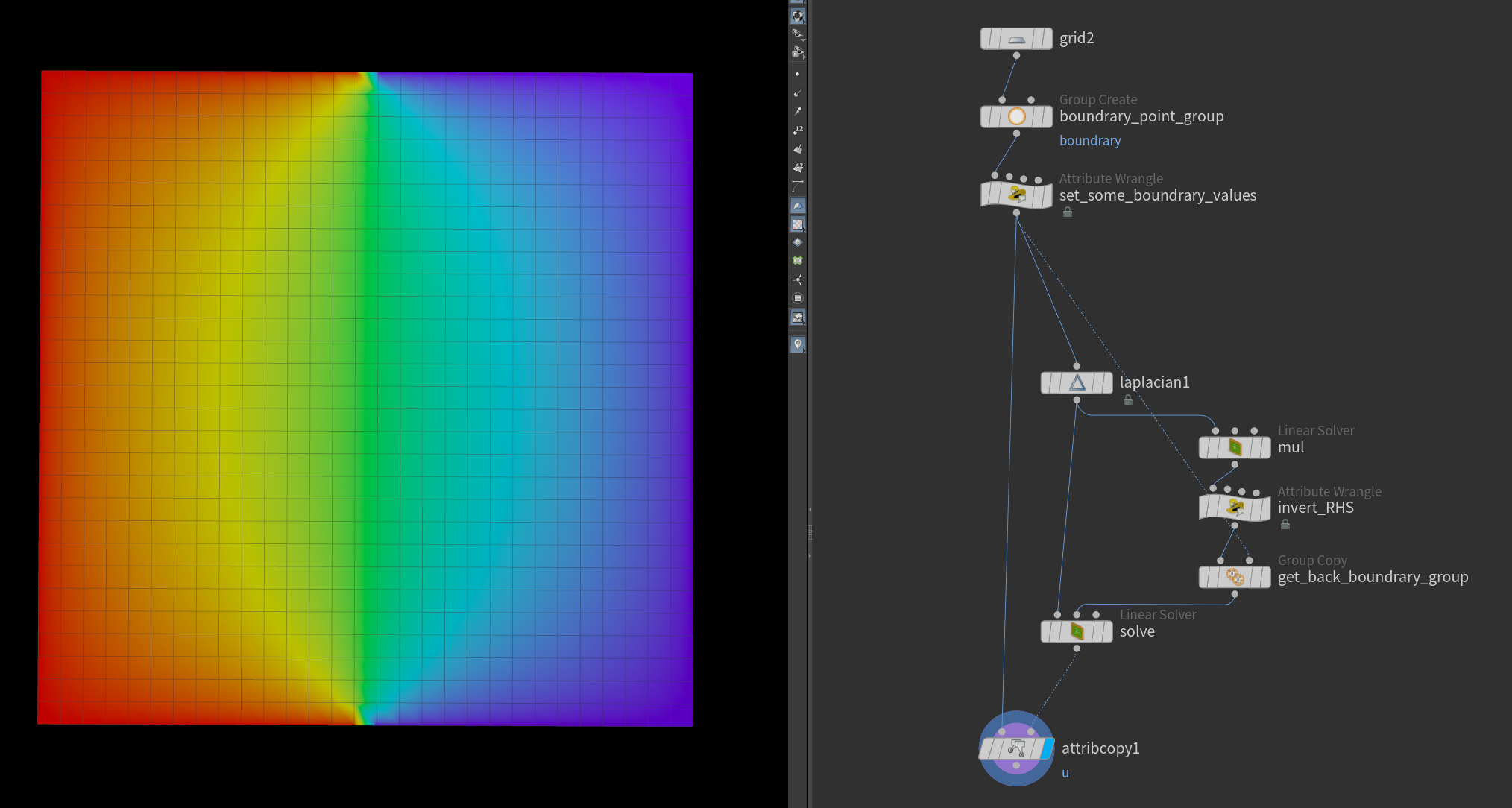
I’m trying to wrap my head around the linear solver node. Since there is very little out there on its functionality I thought I might share this very simple initial setup i cobbled together that just does an “attribute fill”.
it was painful to get this working. wish i had @jake rizzler 😮 brains.
Attachments in this post:
http://fx-td.com/houdiniandchill/wp-content/uploads/discord/20253709/12/25/attribute_fill_using_linear_solver.hiplc
http://fx-td.com/houdiniandchill/wp-content/uploads/discord/20253709/12/25/image.png
I don’t like how the guide process core and hairgen core are C++
great nodes, but the decision to make them C++ operators locks you out of some of the building blocks
there’s also a nasty bug in a couple of those hardcoded nodes
“`Hello, I have found that using hairgen SOP to generate guides will result in making: skinprimuv 3flt, but is using guidegroom(in for example draw, or plant, or any mode that creates guides) it will make: skinprimuv 2flt16 This comes down to the guidegroomcore and hairgencore spitting out the different bit depth/types. That will cause groomblend to break, as it reports it “cannot find skinprimuv” , the error coming from the guidemaskcore node, another C++ hardcoded base node.“`
love the toolset, but not sure the speed increase reason was good enough to make these into compiled nodes
@astv this you? 1minutevex.com/books/OneMinuteVex.html
lovely stuff
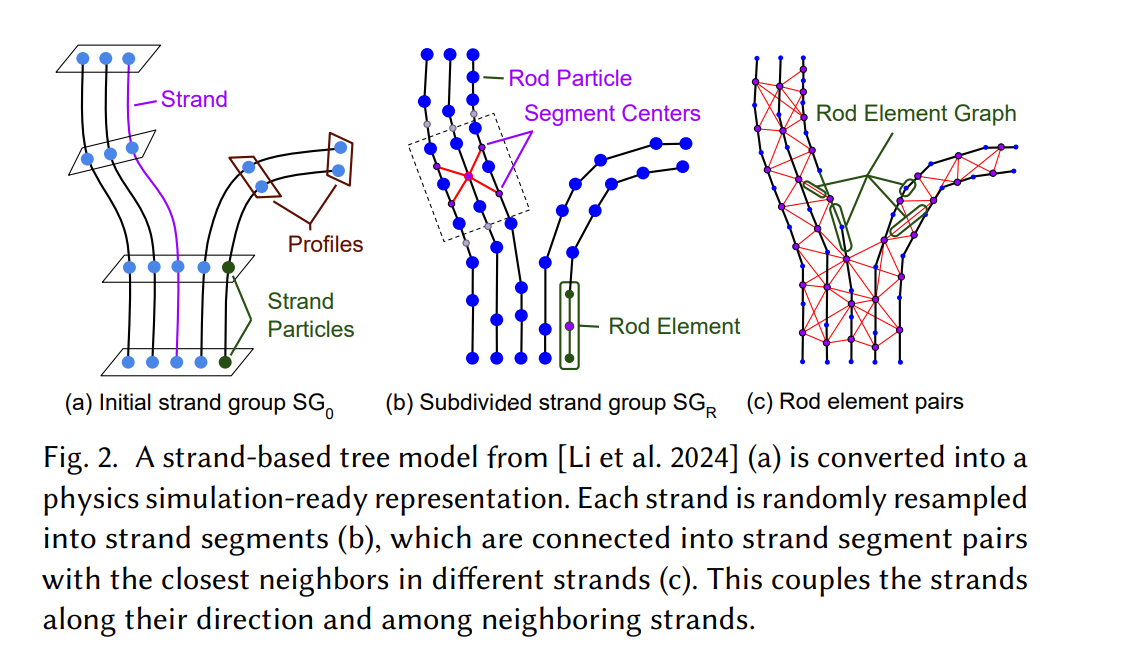
I will say for tree sims that i’ve found a lot of the suggestions from this paper from this year’s siggraph to be really helpful: storage.googleapis.com/pirk.io/projects/stressful/index.html
Here’s the method that seems to work for me! The input is a connected set of tree edges, with pscales, and branch_ids: Generate a bunch of fake tree strands (i use find shortest path from every point in the tree, back to the root). Generate an orientation frame along the findshortest path curves (orient along curve). Randomly rotate the resulting normals strand wise (so every normal in a strand is rotated the same amount). Then I offset the resulting curves along the normal multiplied by pscale and a random value from 0-1 per strand Then you randomly resample them and subdivide ( i wrote my own stupid little subdivide node, just to add exactly one point at the midpoint between any two points on a given strand). Then you make glue constraints between nearest subdivided points on the same branch (taking advantage of our branch_id attribute). And then lastly you can embed your original tree curves into this as well with glue constraints, so you an easily extract it post sim.
But this seems to do a good job of letting you really get stiff results with vellum, like a wire solver. And then you can inject forces at brinch tips (leaves) and ideally the forces will propagate.
i find that the random resampling and subdivision is like incredibly important to add structure to the wires. Because otherwise the distribution of glue constraints is too regular, and it causes the whole thing to buckle
Oh and in my case i would turn off self collisions because i didnt want to recompute pscales for the strands out of laziness. But you’ll need to compute non intersecting pscales if you want to keep self collision on
I’ll see if i have any time today to whip up an example
Attachments in this post:
http://fx-td.com/houdiniandchill/wp-content/uploads/discord/20251808/08/25/image.png
neat trick: https://www.youtube.com/watch?v=B9vy-y0gxfo