Archived post by vanity_ibex

I should start using recipes more then I don’t have to dig through 100x files to find something
“`cpp
#bind layer src float4 #bind layer &dst float4 #bind parm radius int value=4 #bind parm sigma_s float value=4.0 // spatial falloff #bind parm sigma_r float value=0.1 // range/value falloff
@KERNEL { int2 gid = (int2)(@ix, @iy); int w = @src.xres; int h = @src.yres;
float4 center = (float4)(@src.bufferIndex(gid)); float4 acc = (float4)(0.0f); float weight = 0.0f;
float ss2 = 2.0f * @sigma_s * @sigma_s; float sr2 = 2.0f *max(@sigma_r,0.001f) * max(@sigma_r,0.001f);
int r = @radius;
for (int dy = -r; dy <= r; dy++) { for (int dx = -r; dx <= r; dx++) { int2 p = (int2)( clamp(gid.x + dx, 0, w-1), clamp(gid.y + dy, 0, h-1) );
float4 sample = (float4)(@src.bufferIndex(p));
// Spatial weight — gaussian falloff by pixel distance float spatial = (float)(dx*dx + dy*dy) / ss2;
// Range weight — gaussian falloff by value difference float4 diff = sample – center; float range = dot(diff, diff) / sr2;
float w_combined = exp(-spatial – range);
acc += sample * w_combined; weight += w_combined; } }
@dst.set(acc / weight); }
“`
Archived post by lwwwwwws

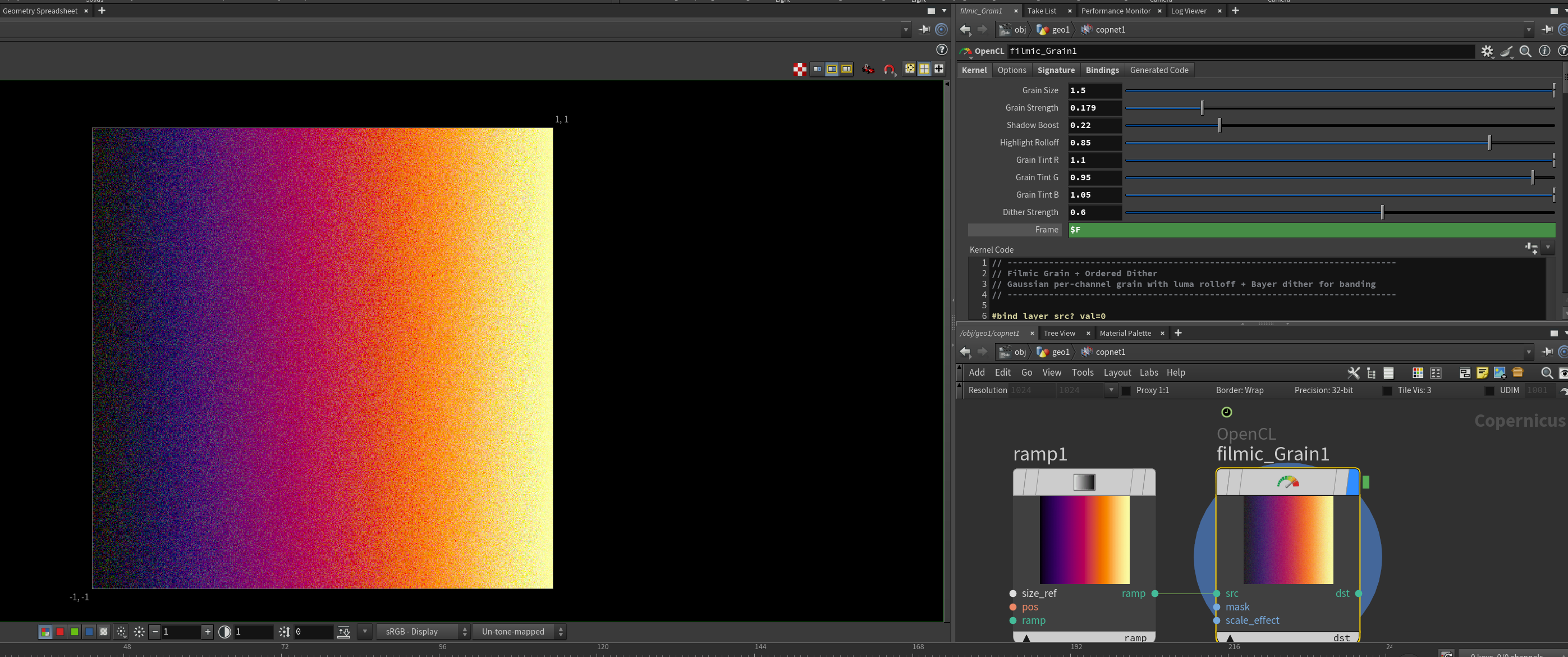
kuwahara is a cool trick but it does date from 1976, bilateral filters are a more controllable and better behaved way to filter while avoiding edges… here’s one i use a lot in comp and just translated from glsl to opencl

it works ok on bacon but i do feel like it could be improved 🤔 it’s the kind of thing that works better in log than linear and the threshold control might be better if it was a hard cutoff so colours past a certain distance are ignored, instead of this drastic pow() curve thing i’m doing

Attachments in this post:
http://fx-td.com/houdiniandchill/wp-content/uploads/discord/20261102/08/26/Screenshot_2026-02-08_at_16.18.15.png
http://fx-td.com/houdiniandchill/wp-content/uploads/discord/20261102/08/26/Screenshot_2026-02-08_at_16.17.55.png
http://fx-td.com/houdiniandchill/wp-content/uploads/discord/20261102/08/26/Ls_Dollface_v01.cl

Archived post by vanity_ibex

Ported Mild Slope Equation Solver to COPs (Fancy Ripple Solver)

wrote a little bit about it here: vanity-ibex.xyz/blog/mildslopeequation/

Attachments in this post:
http://fx-td.com/houdiniandchill/wp-content/uploads/discord/20264801/13/26/Mild-Slope_Equation_09.rop_image1.0001_output_compressed_crf20.mp4
http://fx-td.com/houdiniandchill/wp-content/uploads/discord/20264801/13/26/Mild-Slope_Equation.hiplc

Archived post by mysterypancake

dumb cops question – does anyone know how to get the size of the volume in hscript?

i thought volumeres but no luck 🙁

finished prefix sum, now around 15x faster 👀

also the iterations can be animated now

Attachments in this post:
http://fx-td.com/houdiniandchill/wp-content/uploads/discord/20263801/12/26/image.png
http://fx-td.com/houdiniandchill/wp-content/uploads/discord/20263801/12/26/prefixsum.mp4
http://fx-td.com/houdiniandchill/wp-content/uploads/discord/20263801/12/26/cops_fast_prefixsum.hiplc
http://fx-td.com/houdiniandchill/wp-content/uploads/discord/20263801/12/26/prefixsum_animate.webp

Archived post by kolupsy

a while ago I thought it would be fun to try and optimize the “equalize” node. It’s not perfect since I don’t think cops allows image inputs of different sizes but it seems to run faster than the builtin “equalize” node by using a more parallel-friendly algorithm. Thought I’d drop that here in case anybody is interested

Attachments in this post:
http://fx-td.com/houdiniandchill/wp-content/uploads/discord/20260001/10/26/cops_fast_normalize.hipnc
http://fx-td.com/houdiniandchill/wp-content/uploads/discord/20260001/10/26/image.png