Archived post by heimlich

there’s a story to it…

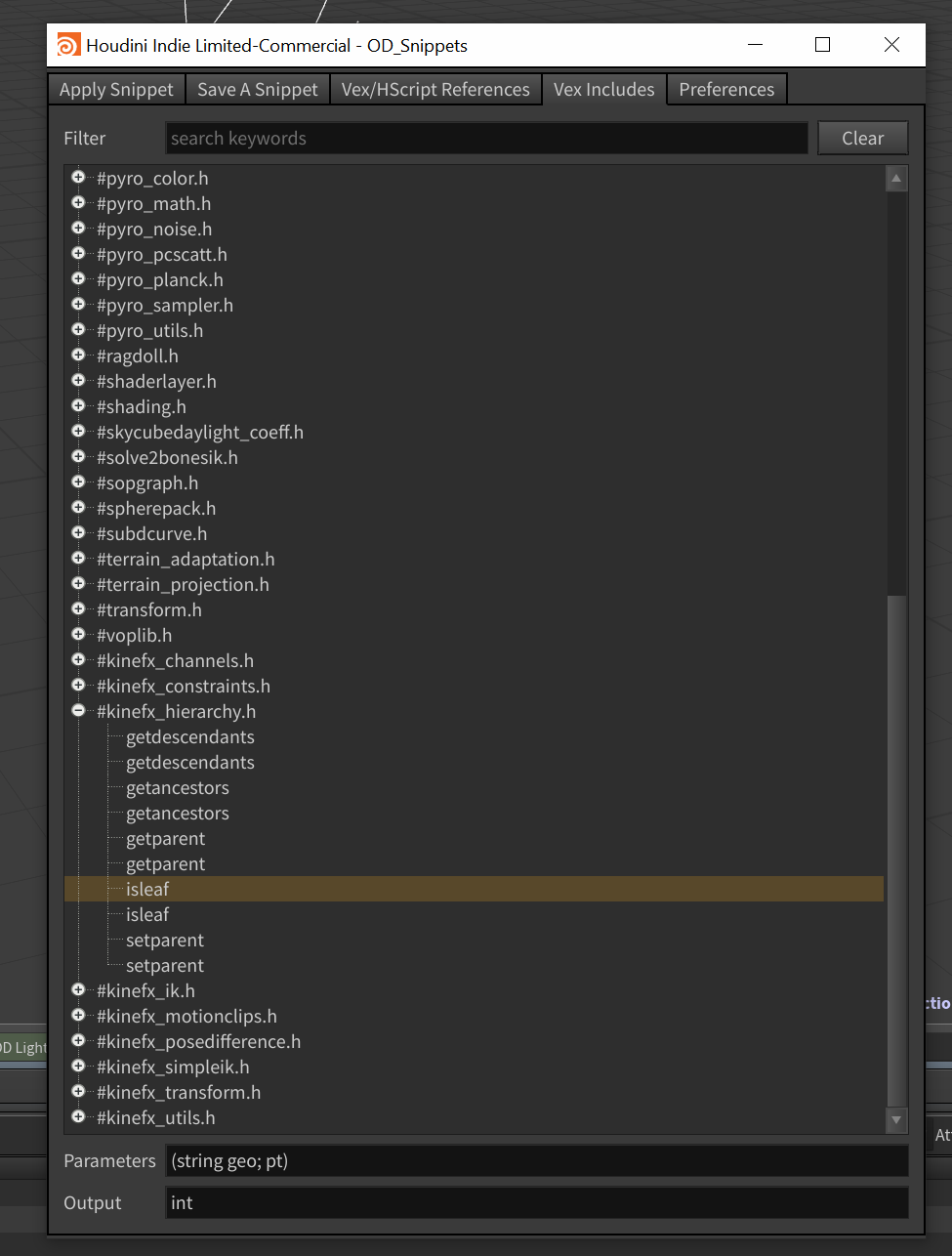
a while back, I asked how to do a saw function.. and this dude called @mestela blurted out “oh.. there’s a saw function in pyro.h” and i just thought.. wtf… first.. whats pyro.h, second, how the fuck would you even know about it….. so.. then I investigated a bit, and turns out, there’s a shitload, of that functionality in these includes… so in odtools, i added a section in the snippet manager, that lists and lets you search for all these functions… like this….

there’s a LOT of functionality, that, i dont know that is searchable in any other form… and in a way, thats a real shame. cause how would you know these functions exist

Attachments in this post:
http://fx-td.com/houdiniandchill/wp-content/uploads/discord/20221005/14/22/unknown.png

Archived post by profbetis

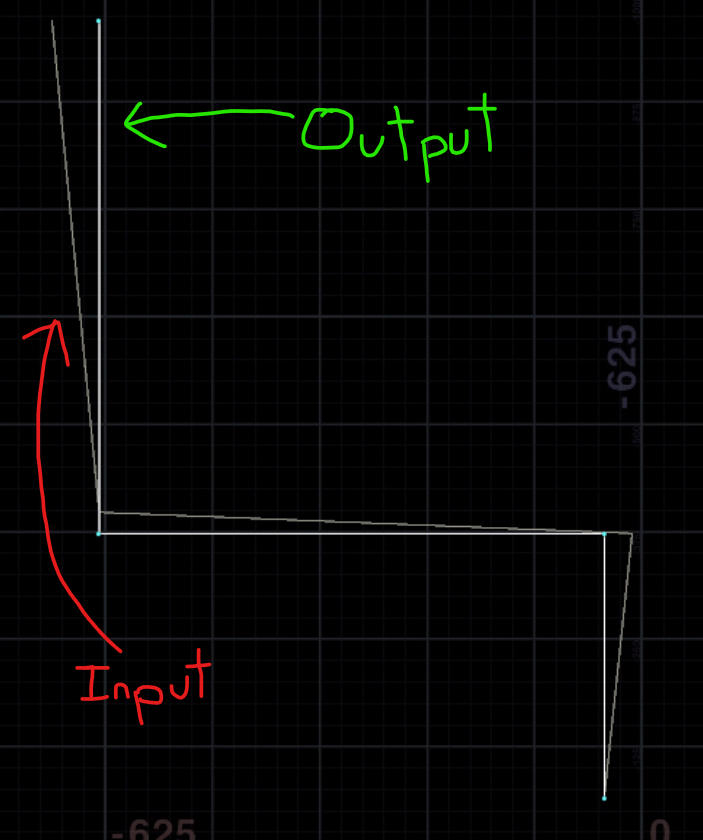
made a neat lil vex thing. Takes a sloppy hand-placed input curve and straightens it up for you on major axes. Doesn’t support diagonal lines yet. Has one control for maintaining segment length (as opposed to picking the closest spot to the original vertex position). Runs as a prim wrangle.
“`c int points[] = primpoints(0, @primnum); vector prev_pos = point(0, “P”, points[0]); foreach( int idx; int pt; points[1:] ){ vector this_pos = point(0, “P”, pt); vector dir = normalize(this_pos – prev_pos); float dist = distance(this_pos, prev_pos); // Determine dominant direction axis vector new_dir; vector abs_dir = abs(dir); if( abs_dir.x > abs_dir.y ){ if( abs_dir.x > abs_dir.z ) new_dir = sign(dir.x)*{1,0,0}; else new_dir = sign(dir.z)*{0,0,1}; } else { if( abs_dir.y > abs_dir.z ) new_dir = sign(dir.y)*{0,1,0}; else new_dir = sign(dir.z)*{0,0,1}; } int maintain_length = chi(“maintain_length”); vector new_pos = prev_pos + new_dir*dist; if( !maintain_length ) new_pos *= dot(dir, new_dir); setpointattrib(0, “P”, pt, new_pos); prev_pos = new_pos; }“`

finally got to use the dot product for something other than checking if two vectors point in the same direction! <:cross_gang:863101157307449365>

Attachments in this post:
http://fx-td.com/houdiniandchill/wp-content/uploads/discord/20220205/11/22/unknown.png

Archived post by heimlich

one sec

getting the report

this is what i initially submitted:
i, I was trying to find some of the slowdowns that occur when Houdini stats on windows, and while looking at things with sysinternals “process monitor”.
Looking at events that happen it seems to add /scripts/sop or /scripts/vop and some labs viewerhandle/state, or install… which. of course does not exist. And it does this with 1000’s of files, the more you have, the more it happens. This take a considerable amount of time, and i am just wondering, if this is something that you assume to happen, or if there could potentially be an issue
And this is what i got from support.. This has was by design for flexibility but this has long come up as a sore point. You can try disabling this mechanism (at the risk of breaking packages that rely on this behaviour) by setting the undocumented `HOUDINI_EXPERIMENTAL_DISABLE_EVENTSCRIPT_PATHSEARCH` environment variable to `1` prior to starting Houdini.

I have a lot of packages running, and so far, i havent come across one thats “broken” due to this

Archived post by SniperJake945

One thing I neglected to mention in that post is xyzdist and mindist both require primitives in the geo stream you’re looking up

So they aren’t totally apples to apples with nearpoints/pcfind

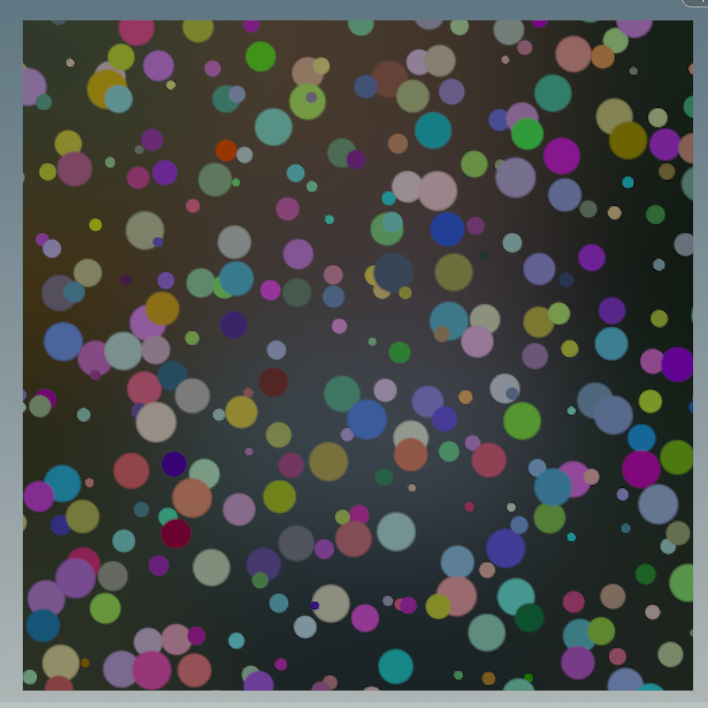
okay i couldnt help myself, but here’s single pass random overlapping dots “`c #include #include
vector dots(vector2 uv_in; vector2 freq; float rand_position, rand_scaling, rand_exp, dot_sharpness, alpha_out){ vector2 uv = uv_in; uv *= freq; vector2 iuv = floor(uv); vector2 grid = frac(uv); float alpha = 0; vector color = 0; float sharpness = fit(dot_sharpness, 0, 1, .5, 1); for(int i = -1; i <= 1; i++) for(int j = -1; j <= 1; j++){ vector2 nb_pixel = set(i, j); vector2 nb_offset = vector2(rand(iuv + nb_pixel + 324)) * clamp(rand_position, 0, 1); //random positional offsetting vector nb_color = vector(rand(iuv + nb_pixel + 64)); float nb_dot_size = pow(fit01(rand(iuv + nb_pixel), max(1 - rand_scaling,0), 1), rand_exp); //random scaling float nb_dots = length(nb_pixel + nb_offset - grid) - nb_dot_size; nb_dots = -min(0.0, nb_dots / nb_dot_size); //convert from distance field to dot nb_dots = smooth(1. - sharpness, sharpness, nb_dots); //sharpening the dots vop_composite("AoverB", color, alpha, nb_color * nb_dots, nb_dots, color, alpha); } alpha_out = alpha; return color; } vector2 uv = set(v@uv.x,v@uv.y); float sharpness = ch(“sharpness”); vector2 freq = chu(“dot_freq”); float random_dot_scaling = ch(“rand_scaling”); float random_exponent = ch(“rand_exponent”); vector2 offset = vector2(chu(“offset”)); float rand_offset = ch(“rand_dot_offset”); float dots_alpha; vector random_dots = dots(uv + offset / freq, freq, rand_offset, random_dot_scaling, random_exponent, sharpness, dots_alpha);
/* comp dots over incoming color*/ float alpha_out = 0; vop_composite(“AoverB”, v@Cd, alpha_out, random_dots, dots_alpha, v@Cd, 1); “`

Attachments in this post:
http://fx-td.com/houdiniandchill/wp-content/uploads/discord/20224804/14/22/unknown.png
Archived post by eetu

I needed again to get an axis-aligned Largest Interior Rectangle, and @jake rice 😮 earlier solution didn’t cut it (too much obvious failure cases, even with @CoskuTurhan modifications), so I did a new one from scratch. It’s based on this algorithm (without the outline optimizations) github.com/lukasalexanderweber/lir

I started with a more-nodes-less-vex approach, so it’s a bit of a weird combination. But seems to work 😉

Attachments in this post:
http://fx-td.com/houdiniandchill/wp-content/uploads/discord/20224903/28/22/ee_largest_interior_rectangle.hip